Demystifying the Cloud: A Beginner's Guide to Enterprise Cloud Infrastructure
The modern enterprise computing landscape has undergone a monumental shift. A few decades ago, launching a digital business or scaling a software application required massive physical infrastructure. Companies had to purchase expensive physical servers, rent secure warehouse space, configure complex air conditioning systems to prevent overheating, and employ dedicated teams of hardware engineers just to keep the machines running.
If a sudden spike in customer traffic hit the website, the physical servers would overload and crash. Fixing the issue meant ordering more hardware, waiting weeks for shipping, and manually racking the new components in the data center.
Today, that physical friction has completely evaporated. With a few clicks of a mouse or a single line of automated code, an organization can spin up thousands of virtual computers, massive databases, and global networks spanning multiple continents in a matter of seconds.
This entire revolutionary paradigm shift is powered by Cloud Computing.
Yet, despite its ubiquity, the "cloud" remains an deeply misunderstood concept for technology beginners. It is often spoken about as an abstract, invisible, almost mystical entity floating in the ether.
In reality, the cloud is highly physical, exceptionally structured, and represents one of the most powerful engineering achievements of modern human history. For anyone aspiring to build a career in IT, cybersecurity, or data analytics, mastering the foundational principles of enterprise cloud architecture is no longer optional—it is a mandatory survival skill.
1. What Actually Happens When You "Move to the Cloud"?
To truly demystify the cloud, we must discard the marketing fluff and look at the physical reality. The most accurate, grounded definition of cloud computing is simple: The cloud is someone else's exceptionally advanced, hyper-scaled data center that you rent access to over the internet.
When an enterprise decides to migrate its operations to a public cloud provider—such as Amazon Web Services (AWS), Microsoft Azure, or Google Cloud Platform (GCP)—they are not deleting their software or sending it into the sky. Instead, they are moving their digital assets off their own limited, on-premise hardware and placing them into massive, heavily fortified industrial data centers owned by these tech giants.
These cloud data centers are the size of football fields, housing hundreds of thousands of high-performance physical servers stacked neatly in steel racks. They are protected by military-grade physical security, biometric access controls, redundant electrical grids, and automated fire suppression systems.
By renting space in these facilities, everyday businesses gain access to a level of engineering infrastructure, security, and global reach that would cost billions of dollars to build independently.
The fundamental financial model of computing changes under this paradigm. Companies transition from a capital expenditure model (buying expensive hardware upfront) to an operational expenditure model (paying for computing resources on an ongoing, utility-style basis). You pay for computing power exactly the same way you pay for electricity or water: you are billed precisely for what you consume, down to the exact second of execution time.
2. The Core Magic: Understanding Virtualization and Hypervisors
How can thousands of completely different corporate clients safely run their software on the exact same physical server hardware without seeing or interfering with each other's data? The answer lies in a foundational technology known as Virtualization.
Virtualization is the software process that separates physical hardware components from the operating systems that run on them. In a traditional computing model, one physical machine runs one operating system (like Windows Server or Linux). This configuration is highly inefficient, as the software rarely utilizes more than 10% of the underlying hardware's actual processing power, leaving the remaining 90% completely wasted.
With virtualization, a specialized software layer called a Hypervisor is installed directly on top of the physical server's hardware.
[The Virtualization Stack]
-----------------------------------------
| Virtual Machine A | Virtual Machine B | <-- Independent Operating Systems
-----------------------------------------
| Hypervisor | <-- The Hardware Resource Allocator
-----------------------------------------
| Physical Server | <-- Actual CPU, RAM, and Storage
-----------------------------------------
The hypervisor acts as a strict, intelligent traffic cop. It abstracts the physical central processing units (CPUs), random-access memory (RAM), and hard drive storage into isolated, self-contained digital packages called Virtual Machines (VMs).
To the software running inside it, a Virtual Machine believes it is a real, standalone physical computer with its own dedicated hardware. It boots its own operating system, runs its own applications, and maintains its own file storage.
In reality, the hypervisor is slicing up the physical machine underneath, dynamically carving out processing units and memory blocks to host dozens of distinct Virtual Machines simultaneously.
This architectural separation delivers profound operational benefits:
Total Data Isolation
Even though Virtual Machine A and Virtual Machine B are running on the exact same physical silicon chips, the hypervisor creates an absolute logical boundary between them. Virtual Machine A has no visibility into the memory or data structures of Virtual Machine B, ensuring strict multi-tenant privacy and enterprise security.
Rapid Resource Scalability
If a virtual server requires more processing power to handle a temporary workload, an administrator does not need to open a computer case and plug in more RAM chips. The hypervisor can programmatically allocate more resources from the physical hardware pool to that specific Virtual Machine instantly, without requiring a system reboot.
Snapshot Hardware Agnosticism
Because a Virtual Machine is essentially just a collection of software files configured by the hypervisor, it can be easily backed up, duplicated, or moved across completely different physical data centers around the world with zero downtime.
3. The Enterprise Cloud Service Models: IaaS, PaaS, and SaaS
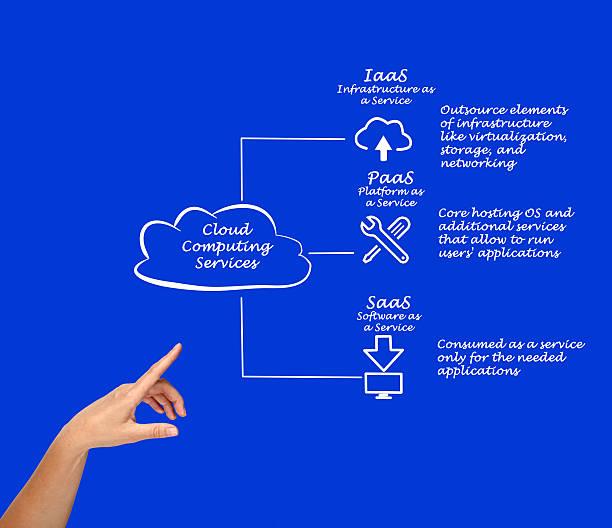
When building an enterprise infrastructure in the cloud, you do not have to manage every single layer of the technology stack yourself. Cloud providers offer different tiers of service, categorized by how much management responsibility falls on the provider versus how much falls on you as the customer.
These tiers are divided into three primary service models:
Infrastructure as a Service (IaaS)
Infrastructure as a Service represents the most fundamental, flexible tier of cloud computing. In an IaaS model, the cloud provider supplies you with raw building blocks over the internet: the virtualized servers, network architectures, firewalls, and data storage systems. You have complete administrative control over the entire system.
You are responsible for selecting, installing, and maintaining the operating system, configuring the network rules, patching security vulnerabilities in the software, and deploying your own applications. Examples of IaaS include Amazon EC2 instances or Azure Virtual Machines.
This model is ideal for enterprise infrastructure teams who require absolute control over their underlying operating environment.
Platform as a Service (PaaS)
Platform as a Service abstracts away the operating system layer entirely, allowing developers to focus exclusively on writing application code. In a PaaS model, the cloud provider manages the physical hardware, the virtualization hypervisors, the underlying operating system, and the database execution engines automatically.
You do not need to worry about server updates, operating system patches, or configuring low-level network drives. You simply upload your software code to the platform, and the provider automatically handles the execution, scaling, and system availability. Examples of PaaS include Heroku or AWS Elastic Beanstalk.
This model drastically increases speed-to-market for software development teams by removing infrastructure management overhead.
Software as a Service (SaaS)
Software as a Service represents a fully completed, end-user application delivered entirely over a standard web browser. In the SaaS model, the cloud provider manages absolutely everything: the hardware, the operating system, the code, the user interface, and the backend databases.
You do not build, configure, or maintain any part of the application infrastructure; you simply log in and use the service to execute daily business operations. Examples of SaaS include Google Workspace, Microsoft 365, or Salesforce.
This model offers maximum convenience for everyday business productivity, but provides zero technical customization options for infrastructure engineers.
4. The Modern Cloud Deployment Matrix: Public, Private, and Hybrid
Organizations deploy these cloud service models across various environments based on their specific operational scale, regulatory compliance needs, and architectural preferences. These environments are classified into three distinct deployment models:
Public Cloud
The public cloud is the standard model where infrastructure resources are owned, managed, and operated by a massive third-party provider and shared across thousands of independent corporate tenants over the public internet. This model offers the highest scalability, lowest upfront costs, and zero maintenance overhead for the enterprise.
Private Cloud
A private cloud consists of computing infrastructure dedicated exclusively to a single business organization. The physical hardware can be located on-site at the company’s own private data center or hosted by a third-party service provider.
This model offers total architectural control and maximum data isolation, making it the preferred choice for highly regulated sectors like national defense, healthcare, and global banking operations. However, it requires significant capital investment and continuous internal engineering maintenance.
Hybrid Cloud
The hybrid cloud model combines public and private cloud environments, linking them together with secure network data pipelines. This approach allows an enterprise to enjoy the benefits of both worlds.
For instance, a global bank can store its highly sensitive, confidential customer account data inside a secure private cloud environment to meet strict government privacy laws, while simultaneously leveraging the massive, low-cost processing power of the public cloud to run analytical models or host its public-facing marketing website.
5. Why Cloud Competence is the Ultimate Career Accelerator
The global business landscape has reached a point of total cloud integration. From agile startups to massive Fortune 500 corporations, the modern enterprise runs on cloud infrastructure. This rapid migration has created an immense, structural talent shortage across the global technology workforce.
Organizations are no longer looking for traditional system administrators who only know how to configure physical desktop computers or manual office cables. They are aggressively recruiting professionals who understand how to orchestrate scalable, automated, and secure multi-cloud environments.
The Multi-Disciplinary Impact of Cloud Literacy
No matter which specific technology path you choose to pursue, cloud competence serves as an immediate career force multiplier:
- For Cybersecurity Analysts: You cannot protect an environment you do not understand. Modern security incidents rarely happen on isolated local computers; they happen across complex cloud networks, misconfigured storage buckets, and compromised cloud identity profiles. Understanding cloud architecture allows you to spot vulnerabilities and respond to active cloud threats effectively.
- For Data Analysts: The massive data sets used to drive corporate decision-making are far too large to store on a standard corporate laptop. They live in cloud data lakes and distributed cloud data warehouses. A data professional must understand how to access, query, and process data residing inside these scalable cloud ecosystems.
- For Systems Engineers: The future of IT infrastructure management belongs to automation. Modern cloud engineers utilize code to deploy whole corporate networks automatically, treating infrastructure as software assets. Foundational cloud literacy is the base requirement to enter this high-paying domain.
The Konentra Architecture: Master the Cloud Through Immersive Simulation
Learning enterprise cloud infrastructure through traditional, theory-only methods is notoriously ineffective. You cannot build genuine operational confidence by simply memorizing acronyms from a textbook or watching someone else click through a software platform on a video screen.
To truly understand how a cloud network functions, you must roll up your sleeves, configure the virtual routers, fix the broken permissions, and deploy the architecture yourself.
This hands-on methodology is exactly why Konentra Solutions places experiential learning at the absolute center of our technical training paths.
Our specialized Enterprise Infrastructure and Cloud Architecture Tracks are designed to bridge the gap between abstract theory and real-world workplace competence:
Our Immersive Learning Framework
- Pillar 1: Active Lab Environments: We do not rely on static slide decks. From your very first week, you are placed directly inside active, live cloud sandboxes. You will personally configure hypervisors, spin up isolated Virtual Machines, deploy enterprise web servers, and design secure virtual private networks from scratch.
- Pillar 2: Real-World Fault Troubleshooting: True competence is built when things break. Our instructors deliberately introduce realistic configuration errors, broken network paths, and permissions issues into your lab environments. You will utilize professional monitoring tools and systematic logic to diagnose, troubleshoot, and fix the infrastructure—exactly like a working engineer.
- Pillar 3: The Konentra Job-Simulation Track: The ultimate bridge to professional employment. You transition into our simulated enterprise workspace, taking on the role of an infrastructure associate. You will collaborate on complex technical projects, document your deployments, and build a verifiable professional portfolio that proves to global hiring managers you possess the practical capabilities required to manage an enterprise infrastructure from day one.
Do not let your career ambitions get left behind in a changing job market. Stop reading about the cloud from afar—build the practical, hands-on engineering capabilities that make you an indispensable asset to modern technology teams.
Take Command of Your Technical Future
The digital transformation of the business world is accelerating, and the demand for practical cloud infrastructure competence will only continue to rise. Equip yourself with the hands-on skills, engineering portfolio, and professional confidence required to stand out in the global technology job market.
To start your journey from a technology beginner to an enterprise infrastructure professional, visit us at Konentra Solutions to speak with an academic admissions advisor and reserve your seat in our upcoming experiential cohort.
Recent Insights


Student Reviews
Authentic experiences and reviews from our global training alumni will be displayed right here shortly.
Global Cohort
Advance From Foundation To Technical Leadership
Secure your specialized path tracker in Cyber Analytics, Data Science, or Cloud Systems Engineering.
Join Training Track